
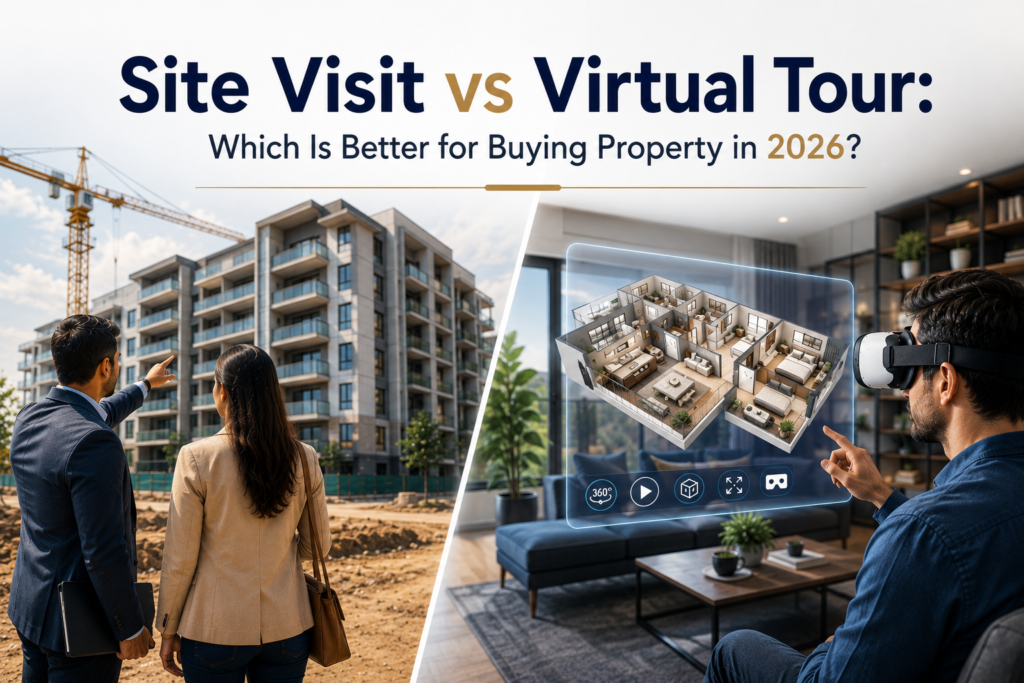
The real estate industry is evolving rapidly.
A decade ago, buyers relied almost entirely on newspaper advertisements, broker calls, project brochures, and physical site visits.
Today, a buyer sitting in Bangalore can virtually walk through a luxury villa in Goa, explore an apartment in Dubai, or inspect a plotted development in North Bangalore without stepping outside their home.
Technology has undoubtedly transformed the property buying journey.
Among these innovations, Virtual Reality (VR) tours have become one of the most talked-about tools in real estate.
Developers showcase them.
Marketing agencies promote them.
Property portals advertise them.
Buyers are becoming increasingly curious about them.
This raises an important question:
Can VR replace a traditional site visit?
After years of observing buyer behavior, one truth remains consistent:
Technology can accelerate decision-making, but it cannot completely replace experience.
Understanding where each tool fits into the buying journey is what separates informed buyers from emotional buyers.
Why This Discussion Matters More Than Ever
The average home buyer today has access to more information than ever before.
Project videos.
Drone footage.
Floor plans.
Virtual walkthroughs.
AI-powered recommendations.
3D visualizations.
Despite all these advancements, buyers continue to make poor decisions.
Why?
Because information is not the same as understanding.
A buyer may spend 50 hours researching online and still miss a critical detail that becomes obvious within 10 minutes of visiting the location.
Real estate remains one of the few investments where digital convenience and physical verification must work together.
The Psychology Behind Property Buying
Unlike buying a phone, a laptop, or a car, real estate decisions are deeply emotional.
People often believe they buy properties based on numbers.
In reality, they buy based on feelings and then justify those feelings with numbers.
When buyers stand inside a property, they begin imagining their future.
They visualize family gatherings.
Morning coffee on the balcony.
Children playing in common areas.
Weekend walks.
Future celebrations.
A screen can display dimensions.
A site visit creates emotional conviction.
That distinction is extremely important.
What a Site Visit Reveals That Technology Cannot
Many first-time buyers underestimate the value of physically visiting a property.
They assume that modern technology can provide all the necessary information.
In practice, some of the most important property insights are impossible to capture digitally.
The Reality of the Neighborhood
A developer can create an outstanding VR experience.
They can showcase beautiful amenities.
They can highlight attractive interiors.
They can present impressive landscaping.
However, VR cannot reveal:
- The actual traffic situation during peak hours.
- Noise levels from nearby roads.
- Future construction activity in surrounding plots.
- The quality of nearby residential communities.
- The overall atmosphere of the neighborhood.
These factors influence daily life far more than most buyers initially realize.
Understanding Connectivity Beyond Google Maps
One of the biggest mistakes buyers make is trusting estimated travel times.
Google Maps might show 25 minutes.
The reality during weekday traffic could be 55 minutes.
A site visit helps buyers understand:
- Actual commute experience.
- Road conditions.
- Accessibility.
- Public transportation options.
- Ease of daily movement.
These practical factors directly affect long-term satisfaction.
Evaluating Construction Standards
Every project looks impressive in marketing materials.
Professional photography hides flaws.
Virtual tours focus on strengths.
Site visits reveal reality.
Buyers can inspect:
- Structural quality.
- Finishing standards.
- Common areas.
- Ventilation.
- Natural light.
- Space utilization.
Many experienced investors insist on physical inspection before committing substantial capital.
There is a reason for that.
Construction quality becomes obvious when experienced eyes examine the project closely.
Why VR Tours Are Becoming Essential
While site visits remain important, dismissing VR would be a mistake.
The most successful buyers today use technology intelligently.
VR solves a significant problem:
It saves time.
A modern buyer may evaluate dozens of projects before making a final decision.
Physically visiting every project is inefficient.
VR helps eliminate unsuitable options early.
A Better First Filter
Think of VR as a highly efficient filtering system.
Instead of spending weekends visiting ten projects, buyers can:
- Review multiple layouts.
- Compare unit configurations.
- Explore amenities.
- Understand floor plans.
- Evaluate overall design.
This allows them to identify serious contenders before investing time in physical visits.
A Powerful Tool for NRIs
For Non-Resident Indians, VR has become particularly valuable.
An NRI living in:
- Dubai
- London
- Singapore
- Sydney
- New York
cannot easily fly to India every time a promising project launches.
VR provides an opportunity to evaluate projects remotely.
While it should not replace due diligence, it significantly improves early-stage research.
Better Visualization of Future Projects
Many premium developments are sold during pre-launch or early construction stages.
At this stage, buyers cannot physically experience the finished product.
VR helps bridge this gap.
It allows buyers to visualize:
- Clubhouses.
- Landscaped parks.
- Apartment interiors.
- Villa communities.
- Future infrastructure.
This helps buyers understand the developer’s vision more clearly.
The Biggest Limitation of VR
The problem with VR is not what it shows.
The problem is what it cannot show.
VR creates an idealized environment.
Reality is often more complex.
A VR tour may show:
- Wide roads.
- Green spaces.
- Peaceful surroundings.
But it may not reveal:
- Future congestion.
- Local infrastructure challenges.
- Water availability concerns.
- Neighborhood quality.
- Social environment.
This is why experienced investors rarely rely solely on virtual experiences.
What Experienced Buyers Actually Do
After years of observing property transactions, one pattern appears repeatedly.
The smartest buyers follow a simple process.
Step 1
Use technology to explore opportunities.
Step 2
Use VR to shortlist options.
Step 3
Visit the most promising properties physically.
Step 4
Conduct legal verification.
Step 5
Evaluate long-term investment potential.
Step 6
Make the final decision.
This approach balances efficiency with risk management.
The Future Isn’t Site Visit vs VR
Many people frame this discussion incorrectly.
They ask:
Which is better?
The real question is:
How can both be used together effectively?
The future of property buying is not about choosing between technology and experience.
It is about combining both.
Technology improves efficiency.
Experience improves confidence.
Together they create better decisions.
A Lesson From Seasoned Investors
If you speak to investors who have bought multiple properties over the years, you’ll notice something interesting.
Almost all of them use technology extensively.
They review data.
They study maps.
They watch videos.
They attend virtual presentations.
Yet before making a final commitment, most still visit the property personally.
Not because they don’t trust technology.
Because they understand the limits of technology.
Real estate is ultimately a physical asset.
And physical assets deserve physical verification.
Final Thoughts
VR is not a gimmick.
Site visits are not outdated.
Both have a valuable role.
VR helps buyers save time, compare options, and explore opportunities from anywhere in the world.
Site visits provide reality, confidence, and context that digital tools cannot replicate.
The smartest buyers don’t choose one over the other.
They use VR to become efficient.
They use site visits to become certain.
And when those two work together, better property decisions follow.
The Golden Rule
Use VR to shortlist.
Use Site Visits to validate.
Use professional guidance to make the final decision.
That’s how informed buyers reduce risk, save time, and invest with confidence.
Burrownest Realty believes that great real estate decisions are built on both innovation and insight. Technology can show you a property. Experience helps you understand whether it’s truly the right one for your future.
Your Future, Addressed.
Great content! Keep up the good work!